
The Meta Ads vs Google Ads question comes up in almost every first call we have with a new client. They have budget set aside, they know they need to advertise, and they want someone to tell them which platform to put the money into.
The honest answer is that neither platform is better. They do different jobs. Google catches people who are already looking for what you sell. Meta interrupts people who are not looking yet and convinces them they want it.
Pick the wrong one and you will spend real money learning an expensive lesson. This breakdown covers how each platform works, what each costs, and how to decide which one your business should start with.
Meta Ads vs Google Ads: the core difference
Everything else in this comparison comes back to one distinction.
Google runs on intent. Someone types a query because they want something right now. They are searching, comparing, and often ready to buy. Your job is to be the clearest, most credible result on that page.
Meta runs on attention. Nobody opens Instagram hoping to find a plumber. They are scrolling, half paying attention, and your ad has to earn a second of their focus before it earns a click.
This is why the same offer can perform completely differently on each platform. A product people already search for by name does well on Google. A product nobody knows exists yet has to be introduced on Meta first.
How Google Ads works
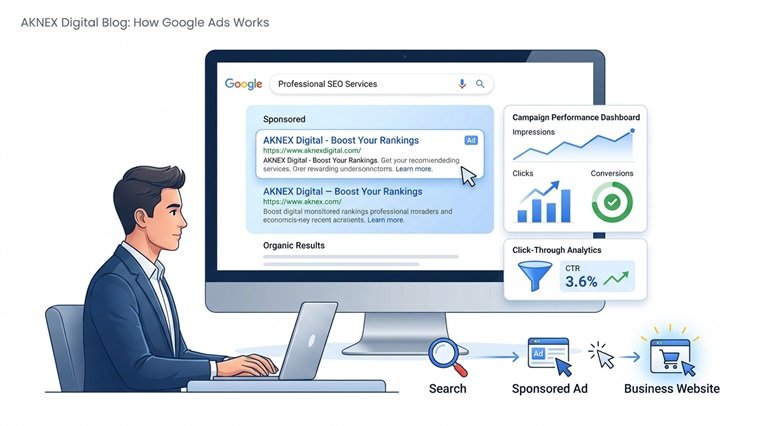
You bid on keywords.This is the channel we manage most often for clients who need paid advertising that pays for itself. When someone searches a term you are targeting, your ad appears above or beside the organic results.
Where it wins
Google wins when demand already exists. If people are actively searching for your service, you can reach them the same day you launch. There is no warming up period and no audience to build. You write the ad, set the budget, and start appearing.
It also wins on measurability. You can see the exact search term that triggered every click. That level of clarity makes it much easier to cut waste and double down on what works.
Where it struggles
Costs climb fast in competitive categories. If several businesses are bidding on the same keyword, the price per click rises until someone drops out.
It also cannot create demand. If nobody is searching for your product, there is nothing to bid on. Google will not introduce a category to someone who has never heard of it.
And the click does not guarantee attention. Someone searching a broad term may click your ad, realize it is not what they wanted, and leave. You still pay for that click.That is why landing page optimization matters as much as the ad itself.
How Meta Ads works
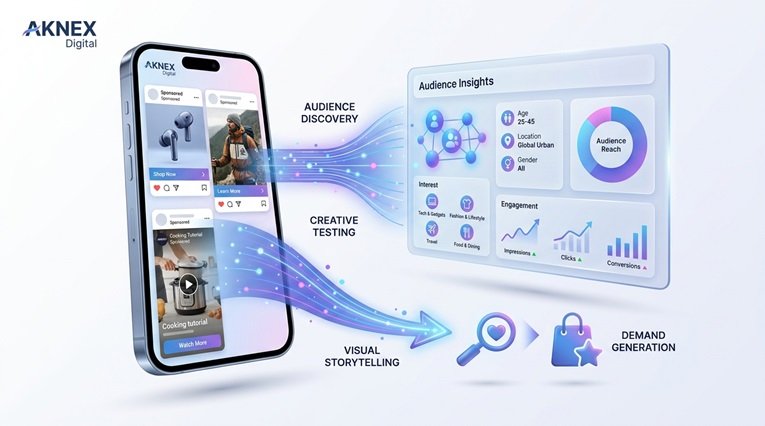
You target audiences instead of keywords. Meta uses the interests, behaviors, and demographics people show across Facebook and Instagram, then shows your ad to the groups most likely to respond.
Where it wins
Meta wins at creating demand. You can put your product in front of thousands of people who have never heard of you and give them a reason to care. For new products and niche services, that is often the only way to get started.
It also tends to cost less per click. In most markets, Meta clicks are cheaper than Google clicks. That gives you more room to test creative and find an angle that resonates.
Visual products do especially well. If what you sell looks good in a photo or a short video, Meta gives you a natural advantage.
Where it struggles
Intent is lower, so conversion rates are usually lower too. Someone who clicks your ad while scrolling is far less ready to buy than someone who typed a buying keyword into Google.
Creative fatigue sets in quickly. An ad that performs well in week one can lose effectiveness by week four as the same audience sees it repeatedly. You need a steady supply of new creative to keep performance stable.
Attribution is messier. People see your ad, do not click, and buy three days later through a different route. That purchase often gets credited to the last channel rather than the one that created the interest.
Side by side comparison
This table summarizes the Meta Ads vs Google Ads decision at a glance. Use it as a quick reference, then read the section below to work out which side of it your business falls on.
| Factor | Google Ads | Meta Ads |
| Primary driver | Search intent | Audience attention |
| Best when | Demand already exists | You need to create demand |
| Typical cost per click | Higher | Lower |
| Typical conversion rate | Higher | Lower |
| Time to first results | Days | Days to weeks |
| Creative demand | Lower | High and continuous |
| Targeting basis | Keywords and search terms | Interests, behavior, demographics |
| Attribution clarity | Clear | Messier |
| Best for | High intent services | Visual products, new offers |
How to decide which one to start with
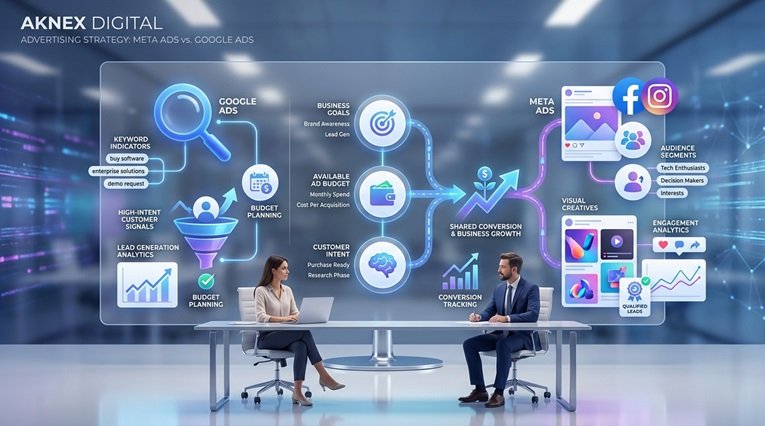
Work through these four questions in order. The first one that applies usually gives you the answer.
Do people already search for what you sell?
Open Google and search your main service. If real competitors are running ads on that term, demand exists and Google is a viable starting point.
If the search results are thin and nobody is advertising, that is a signal. Either the term is not how customers describe the problem, or the demand is not there yet.
Is your product visual?
If someone can understand what you sell by looking at it, Meta gives you an advantage. Furniture, clothing, food, fitness, home services with before and after photos. These all perform well when shown rather than described.
If your product needs explanation, a landing page, or a consultation before anyone understands the value, Google tends to work better because the searcher arrives already informed.
What is your budget?
Small budgets stretch further on Meta because clicks cost less. If you are testing with a few hundred dollars, Meta usually gives you more data for the money.
Larger budgets can support Google even in competitive categories. But be realistic. A tiny budget spread across expensive keywords will burn out before you learn anything useful.
How fast do you need leads?
Google can produce leads the day you launch, assuming the demand exists and your landing page is ready.
Meta usually takes longer to settle. You need to test creative, find your audience, and let the algorithm learn. Expect a few weeks before the numbers stabilize.
You probably do not have to choose
Most businesses we work with end up running both, but not at the same time and not with the same budget split. Organic search is the cheaper long game, covered in our SEO checklist 2026.”
The sequence that works best for most small and mid sized businesses starts with Google. Capture the demand that already exists, learn which messages convert, and build a reliable cost per lead. Then add Meta to reach people who are not searching yet.
That order matters. Google teaches you which claims and offers actually convert. Once you know that, your Meta creative gets better from day one instead of being guesswork.
Some businesses run it the other way. If you are launching something genuinely new, Meta first makes sense. You have to create the category before anyone will search for it.
Three mistakes that waste ad budget on both platforms
We audit a lot of ad accounts. The same problems show up again and again, and none of them are platform specific.
Sending traffic to the homepage
Your homepage has to serve everyone. A landing page serves one audience with one offer and one action. When you send paid traffic to a homepage, you make the visitor do the work of finding what they came for, and most of them will not bother.
Build a dedicated landing page for each campaign. Match the headline to the ad. Repeat the promise. Give them one obvious next step.
Judging results too early
Ad platforms need data before they perform well. Google needs enough conversions to understand which search terms are worth bidding on. Meta needs enough signals to find your audience.
Turning campaigns off after four days is the fastest way to waste the money you already spent. Give each test a defined budget and a defined time window, then judge it against those numbers.
Tracking clicks instead of leads
Clicks are not the goal. Leads are. A campaign with cheap clicks and no leads is worse than a campaign with expensive clicks and a steady flow of qualified enquiries.
Set up conversion tracking before you spend a single dollar. If you cannot see which campaign produced which lead, you are guessing at every decision that follows.
Frequently asked questions
Is Meta Ads cheaper than Google Ads?
Per click, usually yes. Per lead, not always. Meta clicks cost less, but they convert at a lower rate because the intent is lower. Always compare cost per qualified lead rather than cost per click.
Which is better for a small business with a limited budget?
If people already search for your service, start with Google. You will reach buyers with clear intent and learn quickly. If your offer is visual or unknown, start with Meta where small budgets go further.
Can I run Meta Ads and Google Ads at the same time?
Yes, and many businesses should. Just do not split a small budget across both from day one. You will not gather enough data on either platform to make good decisions. Master one, then expand.
How much should I spend to test a new ad platform?
Enough to get statistically useful data, which usually means at least 30 to 50 conversions before you judge performance. Work backwards from your expected cost per lead to find that number. If you cannot afford it, the platform is not the problem. The budget is.Our marketing packages include ad campaign setup and management at each tier.
How long before I see results?
Google can produce leads in the first week if demand exists. Meta typically needs three to four weeks to stabilize. Neither platform works well if you judge it after a few days.
Final thoughts
Meta Ads vs Google Ads is the wrong way to frame the decision. They are not competing for the same job.
Google captures demand. Meta creates it. Most businesses need both eventually, and the only real question is which one to start with based on where their customers are today.
If you are not sure which channel fits your business, we offer free consultations. We will look at your market, your offer, and your budget, then tell you honestly where to start.
Get Your Free Consultation.