
This SEO case study examines a public AKNEX Digital result for a furniture store in the United States. The available Google Business Profile screenshot records 13,470 profile views across Google Search and Maps. It also shows the search terms that placed the business in front of local shoppers.
The result matters because it connects visibility with clear commercial intent. People were not searching for a general article about furniture. They used phrases such as furniture stores near me, furniture stores, and shop living room furniture in PA. Those searches suggest a need, a location, and a possible purchase.
This article stays within what the public evidence can support. It does not repeat the 340 percent traffic claim from the original content calendar because no published AKNEX source verifies that figure. It does not claim that every profile view became a website visit or sale. A credible case study should make the evidence stronger, not make the promise bigger.
The case study at a glance
| Area | Public evidence |
| Client | Furniture store in the United States |
| Channel | Google Business Profile visibility across Search and Maps |
| Recorded views | 13,470 profile views, calculated from the four platform totals shown |
| Largest source | Google Search on mobile, with 8,842 views and 66 percent of the total |
| Leading query | Furniture stores near me, with 1,120 recorded appearances |
| Business relevance | Local shoppers searching for furniture stores, living room furniture, furniture, and couches |
| Evidence source | AKNEX Digital marketing portfolio screenshot from Google Business Profile performance |
The public screenshot is a result snapshot rather than a full campaign report. It does not display the reporting dates, starting baseline, revenue, calls, direction requests, or completed purchases. Those limits do not make the result useless. They tell us which conclusions are reasonable and which details need more evidence.
The published evidence
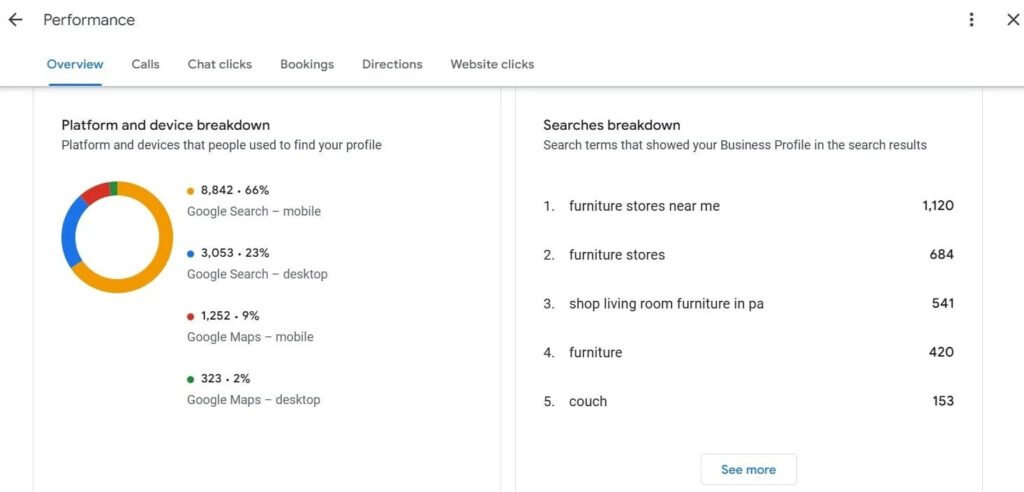
Evidence image: Google Business Profile performance screenshot published on the AKNEX Digital marketing portfolio. The client name is not shown in the public material.
Google explains that Business Profile performance can report searches, views, website clicks, calls, directions, and other interactions. Views record people who saw the profile on Search or Maps. They are different from organic website sessions. This distinction is important because local visibility can begin on Google before a person reaches the website.
The four platform totals in the screenshot add up to 13,470 views. The percentages add up to 100 percent. This gives us a clear view of where discovery happened, even though the screenshot does not give a before and after comparison.
Where the 13,470 views came from
| Platform and device | Views | Share |
| Google Search on mobile | 8,842 | 66 percent |
| Google Search on desktop | 3,053 | 23 percent |
| Google Maps on mobile | 1,252 | 9 percent |
| Google Maps on desktop | 323 | 2 percent |
| Total | 13,470 | 100 percent |
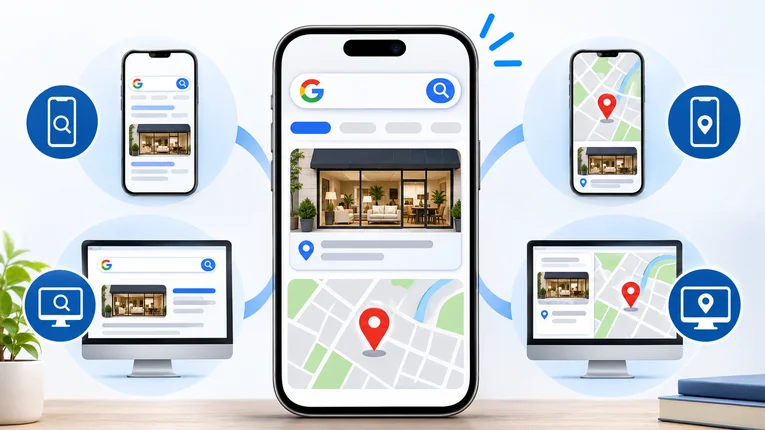
Mobile Search produced almost two thirds of all recorded profile views. Desktop Search added another 23 percent. Search therefore accounted for 89 percent of the visibility, while Maps accounted for 11 percent. The result does not mean Maps was unimportant. It shows that the profile appeared most often while people searched, especially on phones.
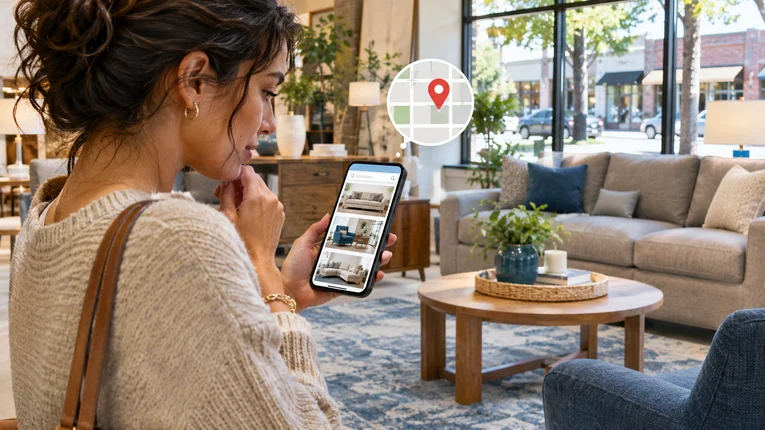
For a furniture store, that behavior makes sense. A shopper may search while comparing nearby stores, checking whether a retailer serves the area, or looking for a particular category. The Business Profile can present the location, website, photos, opening information, reviews, and contact options without making the shopper hunt for basic details.
This device split should influence the work around the profile. Photos need to remain clear on a small screen. Categories, hours, phone details, and the website link need to be correct. The linked landing page should load quickly and make the next action obvious. A local result can attract attention, but the experience after that result decides whether interest continues.
The queries reveal local buying intent
| Search term | Recorded appearances |
| Furniture stores near me | 1,120 |
| Furniture stores | 684 |
| Shop living room furniture in PA | 541 |
| Furniture | 420 |
| Couch | 153 |
The leading query, furniture stores near me, carries strong local intent. The searcher is looking for a business category within a practical area. The second query keeps the same category intent without the near me modifier. The third adds both a product category and Pennsylvania, which makes the need more specific.
These are discovery queries rather than searches for the store name. That matters because discovery visibility reaches people who may not know the business yet. Branded searches are valuable, but they often reflect awareness that already exists. Category and location searches can introduce the store to new buyers.
The product language also suggests content opportunities. Living room furniture and couch are not identical to the broad term furniture. A retailer can use clear category pages, useful product descriptions, location information, and original photos to make those needs easier to match. The goal is not to repeat every query. The goal is to give each important need a useful destination.
What this SEO case study proves
First, local search demand existed around valuable commercial terms. The profile appeared for phrases connected to stores, products, and location. This is more useful than visibility for unrelated informational searches.
Second, mobile discovery dominated the result. A local strategy cannot treat the phone experience as a smaller version of desktop. The profile and linked pages need to support fast decisions, readable product information, easy calls, and clear directions.
Third, Google Search produced far more profile views than Google Maps in this snapshot. Businesses sometimes treat local SEO as a Maps only task. The evidence shows that a Business Profile can support visibility directly within Search as well.
Fourth, query data can shape the next round of work. If a store appears for living room furniture but does not have a strong living room category page, that gap deserves attention. If couch searches produce visibility but weak engagement, the page, product range, price context, or call to action may need improvement.
What the evidence does not prove
This SEO case study does not prove a 340 percent increase in organic website traffic. The public screenshot has no baseline period and does not show Google Analytics sessions. Google also states that Business Profile performance may include activity from organic results and Google Ads. Without account level filters, the exact channel contribution cannot be separated.
The screenshot does not reveal how many views led to calls, direction requests, website clicks, enquiries, store visits, or purchases. Visibility is an early signal. It becomes a business result only when people take a useful next action.
The screenshot also does not document the exact work completed for the client. It would be wrong to invent a list of tactics and present them as project history. A complete private report could include profile changes, page updates, citation work, review activity, content improvements, technical fixes, and the timing of each change. The public result alone cannot confirm those details.
This honesty makes the article more persuasive. Decision stage readers want evidence, but experienced buyers also notice missing context. Explaining the limit of a metric shows that AKNEX Digital understands measurement rather than treating every large number as revenue.
How we can make this post better than a basic case study
A basic case study would publish one screenshot, repeat the largest number, and add a sales pitch. A stronger version explains the source of the number, breaks it into meaningful parts, connects the queries with customer intent, and states what still needs to be measured.
Use a result that can be checked
The evidence should appear close to the claim. This post includes the same result image published in the AKNEX Digital marketing portfolio. Readers can compare the article with the source instead of being asked to accept an unsupported percentage.
Separate visibility from traffic and sales
Profile views, website sessions, leads, and purchases belong to different stages. The article should name the metric precisely. For future client reports, combine Google Business Profile interactions with Search Console, analytics, call tracking, form submissions, and revenue data where access and privacy rules allow.
Turn the data into decisions
A useful case study should help a business owner decide what to do next. The device split suggests a mobile review. The search terms suggest page and product priorities. Missing conversion data suggests a tracking task. These decisions make the post useful even to a reader who is not in the furniture industry.
Protect the client while keeping the proof
The public source identifies the client only as a furniture store in the United States. The post should keep that level of anonymity unless AKNEX has written permission to name the business. Sensitive account data, customer details, and private commercial figures should stay out of the article.
A practical 90 day plan for similar local businesses
The public evidence shows the outcome snapshot, not the exact campaign process. The following plan is therefore a recommended framework for a similar local business. It is not a claim about undocumented work on this account.
Days 1 to 30: fix the local foundation
Confirm the primary and secondary Business Profile categories. Check the business name, address, phone number, hours, service area, website link, and appointment options. Remove duplicate or conflicting listings. Review the linked page on mobile and test the call, directions, form, and product routes.
Audit the website for crawl, indexing, speed, page titles, headings, internal links, and location signals. The technical SEO audit checklist can guide the technical review. Use the keyword research guide to group local queries by category, product, problem, and buying intent.
Days 31 to 60: build useful local destinations
Create or improve pages for important categories and locations only where the business can offer specific value. A furniture store may need strong pages for living room furniture, couches, dining furniture, delivery areas, financing, or showroom information. Each page should answer real buying questions and use original product or store photography.
Connect those pages through clear internal links. The Business Profile website link should lead to a page that matches the main local intent. Product posts and profile updates can point to relevant categories when the content is current and accurate. Avoid making many thin location pages that differ only by a city name.
Days 61 to 90: measure actions and improve weak points
Compare profile views with website clicks, calls, directions, forms, and sales data. Review the queries and landing pages that attract attention. Check whether mobile visitors can find products, availability, delivery information, and contact options without unnecessary steps.
Use Search Console to track clicks, impressions, queries, pages, and countries. Use analytics to study what visitors do after reaching the site. Google recommends reading the two systems together because Search Console covers activity in Google Search while analytics covers behavior on the website.
Keep a change log. Record when profile details, categories, pages, titles, content, links, or tracking were changed. Compare a suitable period before and after the work, and account for seasonality. This makes the next SEO case study more complete because the report can connect actions, dates, visibility, engagement, and business outcomes.
The measurement dashboard this case study needs
| Stage | Metric | Primary source |
| Discovery | Profile views by Search, Maps, and device | Google Business Profile |
| Demand | Queries and query groups | Business Profile and Search Console |
| Engagement | Website clicks, calls, directions, and forms | Business Profile, analytics, and call tracking |
| Website performance | Organic sessions, landing pages, engagement, and conversions | Google Analytics |
| Search performance | Clicks, impressions, click rate, and query trends | Google Search Console |
| Commercial outcome | Qualified leads, store visits, orders, and revenue | CRM, point of sale, or ecommerce platform |
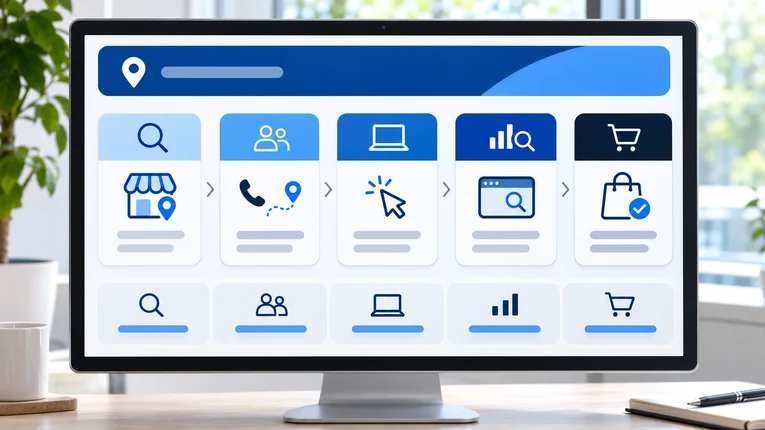
This dashboard prevents one metric from carrying the whole story. A rise in views is encouraging, but it should lead to questions. Did website clicks rise? Did calls become more qualified? Which pages assisted an enquiry? Did revenue change? A marketing report becomes useful when it helps the business choose where to invest next.
Why this topic fits post 9
Posts 1 through 8 explain the AKNEX Digital offer, practical SEO, paid advertising, lead generation, website speed, technical SEO, the growth methodology, and keyword research. Post 9 needs to move from education toward proof. An SEO case study does that without competing directly with a service page.
The topic also supports decision stage readers. They already know what SEO is. They want to see whether AKNEX can connect search visibility with business intent and honest reporting. The public furniture store evidence gives the article a real base, while the measurement framework shows how AKNEX would improve the quality of future reporting.
Readers who want help connecting local visibility with a wider plan can review SEO and organic growth services or start a conversation with AKNEX Digital. The next step should be a discussion about goals, current data, market conditions, and realistic measurement, not a guarantee of identical results.
Frequently asked questions
Are Google Business Profile views the same as website traffic?
No. Profile views record people who saw the business profile on Search or Maps. Website traffic begins when someone clicks through to the site. The two metrics should be reported separately.
Does this result prove a 340 percent traffic increase?
No. The public evidence records 13,470 profile views and their platform split, but it does not provide a starting baseline or organic website sessions. The unsupported percentage was removed from the final topic.
Why are the search terms valuable?
They show how people described the need. Queries around nearby furniture stores, living room furniture, and couches reveal category, product, and location intent that can guide pages, profile information, and reporting.
Can another furniture store expect the same result?
No result should be promised from one example. Demand, competition, location, website quality, inventory, reviews, budget, and execution all affect performance. The case study is evidence of one recorded result, not a forecast for every store.
What would make the next case study stronger?
A dated baseline, a comparison period, a list of completed actions, Search Console data, analytics sessions, profile interactions, lead quality, and revenue attribution would create a fuller account. Client approval would also allow more specific context.
Final thoughts
This SEO case study is valuable because the search terms and platform split reveal how local shoppers discovered the business. The 13,470 views show meaningful visibility around commercial furniture queries, especially on mobile Search. They do not prove traffic growth, leads, or sales on their own.
The better story is not a louder claim. It is a clearer chain from query to profile, from profile to website or contact action, and from that action to a commercial outcome. That is the standard AKNEX Digital should use when this article is published and when the next client result is documented.