
A keyword research guide should do more than produce a long list of phrases. It should help you understand what potential customers want, which pages should answer them, and where your business has a realistic chance to be found. This process turns vague SEO ideas into a working content plan.
Many businesses start with the words they use internally. That is useful, but it is not enough. Customers may describe the same service differently, ask a question instead of naming a service, or use a location and problem in the same search. Good research connects your expertise with the language people already use.
What keyword research is really for
Keyword research is the process of finding and evaluating the words and questions people enter into search engines. The goal is not to repeat a phrase as many times as possible. Google Search Central advises site owners to think about the terms readers may use, including different ways that beginners and experienced users describe the same subject. That is why a useful keyword list contains variations, questions, problems, services, locations, and brand terms.
The business goal comes first. If you sell web development, a phrase such as website cost may attract people who are still comparing options. A phrase such as hire a website developer for a small business may show stronger buying interest. Both can matter, but they deserve different pages and different calls to action.
Use research to make four decisions. Decide what your audience cares about, which topics deserve their own page, what format will answer each query, and which pages should support a commercial action. Without those decisions, a spreadsheet becomes a storage place for ideas rather than a marketing tool.
Start with business language, not a tool
Before opening a keyword tool, write down the services, products, problems, audiences, locations, and outcomes connected to the business. For AKNEX Digital, the starting themes include SEO, paid advertising, lead generation systems, web design, backend development, email marketing, and security. These are seed topics, not final targets.
Add the words a customer might use before they understand the service. A business owner may search for why is my website not getting leads rather than lead generation funnel. Someone comparing agencies may search for affordable SEO help in Oslo rather than SEO and organic growth. These less polished phrases often reveal the questions that a service page or blog post must answer.
Talk to people who handle sales, support, and delivery. Review enquiry emails, chat messages, proposal questions, call notes, and objections. The language customers use in real conversations is often more useful than a list created from industry vocabulary. Keep exact wording where it shows a clear problem, but remove private details before using it in a document.
Build a broad seed list
Create a first list with several groups. Service terms describe what you provide. Problem terms describe the issue the customer wants to fix. Outcome terms describe the result they want. Comparison terms help people evaluate options. Location terms add a city, country, or service area. Brand terms refer to your company or a specific product.
For a web design campaign, the list might include website design for small business, website redesign checklist, how much does a business website cost, fast website design Oslo, and website maintenance after launch. These phrases do not all belong on one page. The list is broad on purpose so you can sort it later.
Include question words such as how, why, what, when, where, and can. Also record phrases that contain words such as price, cost, examples, services, agency, consultant, software, template, audit, and near me. Do not assume every phrase will be valuable. At this stage, your job is to collect the ways a customer may describe the need.
Use search results as evidence
Search each important seed term yourself and study the results page. Look at the page titles, featured snippets, related questions, local results, videos, images, and the wording used by businesses that rank. The results show what Google believes may satisfy the query, although they do not prove that a term is profitable or easy to rank for.
Pay attention to the type of page that appears. If the results are mostly service pages, the query probably has commercial intent. If they are guides and tutorials, an article may be a better fit. If the results are product pages, a category or product page may be needed. When the results are mixed, you may need a page that answers the question and introduces the next step.
Use the related questions and searches as idea sources, not as instructions to copy. Read several results and note the questions they answer. You may find an angle that is missing from the current results, such as a local example, a clearer cost explanation, or a practical checklist. That is where original value can enter the plan.
Understand search intent
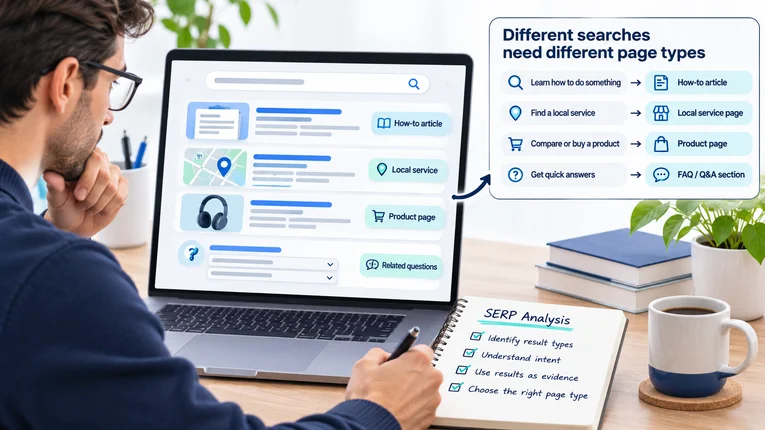
Search intent is the reason behind a query. Informational searches ask for an explanation or process. Commercial investigation searches compare providers, methods, or prices. Transactional searches show that someone is ready to act. Navigational searches look for a particular company, page, or brand.
Intent is not always obvious from one word. The phrase SEO audit may be used by someone learning the subject, someone comparing audit services, or someone looking for a tool. Read the surrounding words and inspect the results before assigning a page type. A keyword research guide should help you make that judgment instead of relying on labels alone.
Match the content to the reason for the search. Use a tutorial for a learning question, a comparison page for evaluation, a service page for a strong buying query, and a contact or consultation page for a direct enquiry. If the page asks readers to buy before answering the question, it may miss the intent and create a poor experience.
Check demand, competition, and business fit
Keyword tools can provide search volume, related terms, competition estimates, and trend data. Treat these numbers as directional evidence, not promises. Different tools use different data sources and models. A phrase with a large volume may bring weak traffic, while a smaller phrase may attract a visitor who is much closer to becoming a client.
Evaluate each candidate through three lenses. Demand asks whether people appear to search for the topic. Competition asks how difficult it may be to earn visibility. Business fit asks whether the visitor could reasonably need what you sell. A phrase that passes all three tests deserves more attention than a popular phrase that has no connection to your offer.
Add a fourth lens: your current authority. A new site may need narrower topics, stronger examples, and useful supporting pages before it can compete for broad terms. That is not a permanent limitation. It is a sequencing decision. Start with topics where the business can provide a clear, specific answer and build outward as the site earns trust.
Group related terms into topic clusters
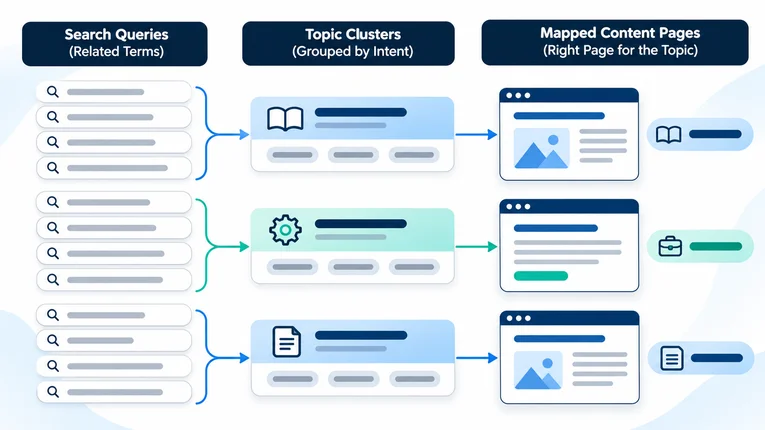
Do not create a separate article for every small variation. Group phrases that share the same intent and can be answered well by one page. For example, website speed tips, how to make a website faster, and improve page loading time may belong to one guide. A separate page may be justified when the audience, intent, or expected action changes.
Choose one primary phrase for each page, then record close variations and questions as secondary terms. The primary phrase gives the page a clear subject. The related terms help you cover the topic naturally. This approach prevents thin pages that repeat the same idea while also making the article more useful to readers who phrase the question differently.
Create a simple map with the target phrase, search intent, page type, target audience, funnel stage, proposed URL, and supporting pages. Add a notes column for evidence from the results page. If two rows point to the same intent and page type, consider combining them. If one row could support a service page and another needs a tutorial, separate them.
Choose the right page before writing
A keyword is only useful when it leads to the right page. Service pages explain the offer, who it is for, what is included, and how to start. Blog posts answer questions, teach a process, compare options, or explain a problem. Case studies provide proof. Location pages explain local relevance. The page type should follow intent rather than the other way around.
Use internal links to connect these pages. A guide about improving lead quality can point readers to lead generation systems when the business service becomes relevant. An article about paid campaign planning can refer to paid advertising without forcing a sales pitch into every paragraph.
Keep the link useful. The anchor should describe the destination, and the sentence should still read naturally after the marker is removed. Avoid vague anchors such as click here. The link should help a reader take the next sensible step, not interrupt the article with an unrelated promotion.
Turn the research into a content brief

Once the terms are grouped, create a brief before drafting. Record the main question, the reader, the desired result, the primary phrase, related phrases, search intent, page type, recommended title, headings, examples, internal links, and call to action. Add a short note explaining what the current results do well and what your page will do better.
A strong brief keeps the writer from forcing every phrase into the copy. It also gives the editor a clear standard. The article should answer the main question early, cover the useful subtopics, use examples that fit the audience, and lead to an appropriate next step. The phrase belongs where it helps the reader, not wherever a spreadsheet says it must appear.
For a page about website design, a relevant internal route could be web design and UI/UX. For a technical article, backend development may be a better next step. Use website design work when proof or examples will help the reader evaluate the service.
Use keyword research to improve existing pages
Research is not only for new articles. Review pages that already receive impressions but few clicks, pages that rank for related terms, and pages that attract visitors who do not enquire. Search Console data can reveal the queries that triggered a page, including phrases you did not plan for. Those phrases may suggest a better title, a missing section, or a new supporting page.
Compare the page with the intent behind the query. Does the introduction answer the question? Is the next step clear? Does the page include proof, pricing context, examples, or location details where readers expect them? Update the content because it needs to serve the reader better, not simply because a phrase appears in a report.
Refresh titles and headings carefully. Keep the promise accurate and avoid stuffing several variations into one heading. Google warns against excessive repetition because it makes content tiring for people and can fall under keyword stuffing. Natural language gives the page room to match related searches without sounding mechanical.
Common keyword research mistakes
The first mistake is choosing a phrase only because its volume looks large. Volume does not tell you whether the visitor is a fit, whether the query is seasonal, or whether the result will lead to a useful business outcome.
The second mistake is targeting one broad phrase with one page and expecting it to answer every audience. A beginner, a marketing manager, and a technical buyer may need different explanations. Narrow the page when the question, reader, or action changes.
The third mistake is treating keyword difficulty as a final verdict. Difficulty scores are estimates. Review the actual pages in the results, assess their quality, and decide whether your business can produce a more useful answer. A weaker score does not replace judgment.
The fourth mistake is writing for a tool instead of a person. Do not repeat the primary phrase in every heading. Do not add awkward variations just to reach a target. Make the page clear first, then check whether the important terms appear in sensible places.
A practical keyword research checklist
Start with the business goal and customer problem. Build seed terms from services, questions, outcomes, locations, and objections. Expand the list using customer language and search results. Record the intent and page type for each useful group. Check demand, competition, business fit, and current authority. Group close variations instead of making thin pages. Choose one primary phrase for each page. Build a brief with headings, examples, links, and a suitable call to action. Review existing pages for new query data. Update the plan as the business and search behavior change.
This checklist works because it connects research to decisions. The output is not a pile of keywords. It is a set of pages with clear jobs, clear readers, and clear next steps. That makes the SEO work easier to brief, write, review, and measure. A keyword research guide should leave you with a short list of pages you can actually produce and improve.
Frequently asked questions
How often should I do keyword research?
Review the main list when you enter a new market, add a service, launch a product, or see a change in customer questions. A light review every few months can catch new language and content gaps. You do not need to rebuild the whole list every week.
How many keywords should one page target?
Use one primary phrase and a group of closely related terms that share the same intent. There is no useful universal number. The page should cover the subject naturally and stop when the reader has the answer.
Should I choose high volume keywords first?
Not always. A narrower phrase with a clear business fit may produce better enquiries than a broad phrase with heavy competition and weak intent. Balance demand with relevance, competition, and the ability to provide a strong answer.
What is the best keyword research tool?
The best setup combines customer language, search results, Search Console data, and a keyword tool. Tools are useful for estimates and discovery, but they do not understand your sales process as well as your team does.
Do I need the exact keyword in every heading?
No. Use the exact phrase where it fits, especially in the title and opening. Use natural related wording in other headings. Clear coverage matters more than repeated wording.
Final thoughts
A good keyword research guide leads to better decisions, not more spreadsheet rows. Start with the customer and the business problem, check how people search, study the pages that appear, and group terms by intent. Then give each group the page, explanation, proof, and next step it deserves.
If you want to connect research with a wider growth plan, review the SEO and organic growth services and compare the work shown by AKNEX Digital. For Google guidance on search terms and keyword stuffing, read the Google SEO Starter Guide. Keep the plan practical, measure the pages that matter, and improve the work as real search and enquiry data comes in.