
Most lead generation advice repeats the same five ideas. This list goes wider. Ten lead gen systems still produce qualified enquiries for businesses that use them properly, including a few that most agencies ignore.
Read it once, then pick two. Testing two channels beats spreading effort across all ten.
Why lead generation strategies fail
Before the list, it helps to know why most attempts fail. We see the same three patterns.
The first is chasing every channel at once. A business sets up paid ads, a blog, a LinkedIn page, an email list, and a webinar funnel in the same month. Nothing gets enough data to work, and everything gets switched off after three weeks.
The second is collecting contacts instead of conversations. A list of ten thousand email addresses means nothing if none of them are the right people. Volume hides the problem until someone tries to sell.
The third is no follow up. A 2021 lead response study of more than 55 million sales activities found that 57.1 percent of first call attempts happen more than a week after the enquiry arrives, and that responding within the first five minutes is worth about eight times the conversion rate of waiting Insider Sales. The businesses that win are usually just the ones that kept going.
Keep those three in mind. Every strategy below works, but only if you give it time, aim it at the right people, and follow up properly.
10 lead generation strategies that still work
Here are the ten, ordered roughly from cheapest and slowest to fastest and most expensive. That order is useful because it tells you where to start.
1. Search engine optimization
Ranking for the terms your buyers search is still the cheapest source of qualified leads over a full year. The trade off is time. Expect three to six months before the traffic arrives, and longer before it turns into enquiries.
What makes it work now is depth. A single thin service page will not rank. A cluster of pages that answers every question a buyer asks at each stage of the decision does.
Start here if you have time and a budget that cannot stretch to paid ads. The compounding is worth it. SEO and organic growth.
2. Content that earns email signups
A checklist, template, or calculator given away in exchange for an email address is still the most reliable way to turn a stranger into a contact. The trick is specificity. A generic PDF gets ignored. A template for your exact industry gets saved.
Make the free thing genuinely useful on its own. If it solves a real problem by itself, the reader trusts you enough to talk to you about the bigger one.
3. LinkedIn outreach done properly
For business to business, LinkedIn is still the highest quality channel for reaching a specific person at a specific company. The businesses that succeed do not blast connection requests. They publish useful posts for a few weeks, then reach out to people who already know their name.
The outreach message should ask for a conversation, not a purchase. Nobody replies well to a pitch in the first message.
4. Referral and partner programs
The cheapest leads come from people who already trust you. Yet most businesses never ask. A simple system, one clear incentive, and a monthly reminder to existing clients, turns referrals from luck into a channel.
Partners are the bigger version. A company that serves the same client but does not compete with you can send you steady work for years if the arrangement is fair on both sides.
5. Webinars and live demos

A live session forces the attendee to spend real time with you, which builds trust faster than any article. The best ones answer one hard question in forty minutes and then make one clear offer.
Record every session. A webinar that runs once becomes a lead magnet that works every day after.
6. Paid search on high intent terms
When someone searches for a service with the intent to buy, being on that results page is valuable. paid search is the fastest way to test a new offer because you can switch it on and measure within days.
The danger is bidding on broad terms and paying for clicks that never convert. Tight keyword lists and negative keywords keep the spend honest.
7. Social proof and case studies
A named client with a real number attached is worth more than any amount of copy. case studies that quote real results do more selling than a page of adjectives.
Collect these systematically. Every finished project should end with permission to publish the result.
8. Email marketing to an existing list
The list you already own is the most underused asset most businesses have. A monthly email marketing with one useful idea and one soft offer costs nothing and keeps you present between purchases.
Segmentation is what makes it work. Sending the same email to everyone wastes the list. Grouping by what they bought or where they are in the process makes each message relevant.
9. Communities and niche forums
Every industry has a place where its people gather. Answering questions honestly in those places, without dropping links, builds a reputation that brings enquiries to you.
This is slow and it will not show up in a weekly report. It compounds quietly and then suddenly matters.
10. Strategic partnerships and integrations
If your software or service connects to another product your buyers already use, a partnership puts you in front of their whole customer base. This is a higher effort channel, but the leads it produces are often the best quality of the ten.
How to choose which two to test
Do not try all ten. Pick two using three questions.
Where does your buyer spend attention? If they search, start with SEO and paid search. If they gather in communities, start there. A great channel aimed at the wrong place wastes money.
What can you sustain for ninety days? A channel you abandon after three weeks teaches you nothing. Choose something you can run properly for a full quarter.
What does each lead cost you? Track cost per qualified lead for each channel and compare. The cheapest channel on paper is often the most expensive once you count your time.
A simple tracking setup that tells you the truth
Most businesses measure the wrong thing. They count leads and stop there, which makes every channel look good until someone tries to sell.
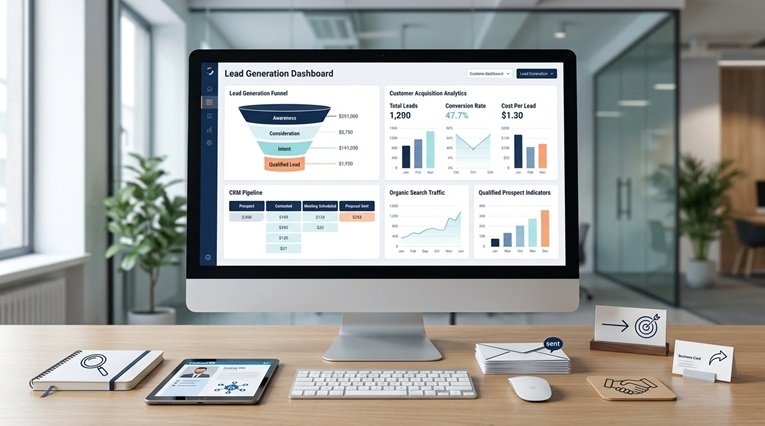
Track four numbers per channel instead. How many enquiries it produced. How many of those were qualified. How many became customers. And what each qualified lead cost you to acquire.
The fourth number is the one that matters. A channel that produces fifty cheap enquiries and no customers is worse than a channel that produces five expensive ones and two sales. Without that comparison you will keep funding the wrong channel because it looks busy.
Keep a single spreadsheet. One row per channel, updated monthly. After three months the answer is usually obvious, and you can stop funding whatever the numbers already told you to drop.
Common lead generation mistakes
Three mistakes show up in almost every account we review.
The first is a landing page that talks about you instead of the visitor. Everything on it is about the company, the awards, the history. The visitor came looking for an answer to their own problem. Lead with that.
The second is asking for too much on the first form. Every extra field costs you a percentage of your conversions. Name and email is enough to start a conversation. You can learn the rest during it.
The third is no response time standard. A lead contacted within five minutes is dramatically more likely to convert than one contacted the next day. If you cannot respond fast, fix that before you spend anything on more traffic.
The follow up problem
Every strategy on this list produces the same output: a name and a contact detail. What happens next decides whether that lead becomes revenue.
Set up a simple sequence. One message within a day of the enquiry, one a few days later with something useful, and one a week later asking for a short call. Most businesses never send the third message, and that is exactly where the leads are.
Record which channel each lead came from. After ninety days you will know which two are worth doubling down on, and you will have real numbers instead of a feeling.
Frequently asked questions
What is the fastest lead generation strategy?
Paid search on high intent terms. You can have traffic and enquiries within a week. The cost is immediate and it stops the moment you stop paying, which is why it works best as a test rather than a permanent foundation.
How many lead generation strategies should I run at once?
Two, maybe three. Each channel needs enough budget and attention to produce data. Spreading effort across ten channels means none of them get that, and you learn nothing about what works.
Is SEO still worth it for lead generation?
Yes, if you can wait three to six months. It is the cheapest channel per lead over a full year and it keeps working while you sleep. If you need leads this month, pair it with paid search and treat SEO as the long game.
What is a good cost per lead?
It depends entirely on what a lead is worth. A lead worth five hundred dollars justifies a cost per lead ten times higher than a lead worth fifty. Work backwards from your average sale instead of comparing yourself to an industry average.
How do I know if a channel is working?
Track three numbers. How many leads it produced, how many of those were qualified, and how much each qualified lead cost. A channel with cheap leads and no qualified ones is worse than an expensive channel that produces buyers.
Conclusion
Ten channels still produce qualified leads in 2026, but the businesses getting results are not using all of them. They picked two, gave each ninety days, and followed up properly.
Start with the channel that matches where your buyer already spends attention. Give it a real budget and a real timeline. Then measure cost per qualified lead and double down on what the numbers support.
Save this list and pick your two. If you want help working out which channels fit your business, talk to our team.